
Car Importation
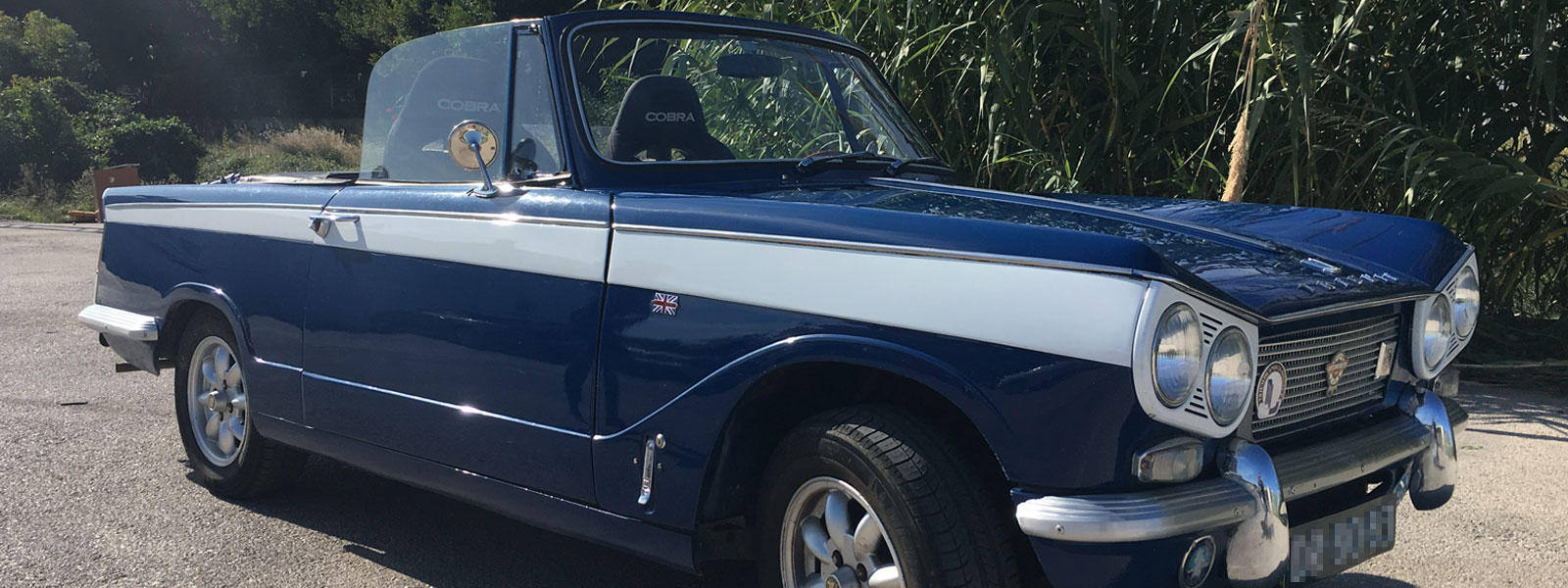
Triumph Vitesse
The advisory information on this page assumes you wish to import a vehicle to Spain from another country .
This advisory information has been prepared for members of MACCC. The club or any of the club officers cannot be held responsible for any dealings you may have with the procedure and experts suggested. It is important that you make your own enquiries and make your own judgement as to the quality of the services offered.
Things to consider before you start:
- This is an outline of the procedure but, please note, rules can often change.
- Importation procedures sometimes differ depending on which country the vehicle is being imported from.
- Different Spanish officials can sometimes apply the rules in different ways.
- A modified vehicle presents its own problems; so please talk to Peter Alt for particular advice.
- The specialists mentioned at the end of this article are ones we have experience of. However, as always, they are only as good as their last job, and you may have a different experience.
- So, as a club, we can only offer our experiences and hope you have a good experience too.
Step 1 – Obtain a Ficha Reducida
First the vehicle to be imported must obtain a Ficha Reducida. This can only be done by a qualified and approved Spanish specialist. The specialist will examine the vehicle and then draw up its technical specification. The examination takes around 45 minutes. The cost is around 150€ at the time of writing. Usually the procedure takes a few days for the paperwork to be produced.
Once you have the Ficha Reducida you can book the ITV and, if the car passes, the Ficha Reducida will be converted to a Ficha Técnica, which is the technical data sheet from the last ITV passed.
Step 2 – Book an ITV appointment
In the UK, we have the annual MOT for keeping our cars roadworthy. The Spanish equivalent of this is the ITV, which stands for Inspección Técnica de Vehiculos.
Armed with the Ficha Reducida paperwork, you can gather all the other paperwork you will need; passport, house deeds or rental agreement, NIE, padron (if applicable), residency permit (if applicable) and the car documents, such as the DVLA V5.
Book online (https://www.sitval.com/#/cita_previa) or go to the ITV centre to make an appointment for the car. It is best to ask them to check you have all the correct papers, which they will usually, happily, do for you. The appointment is usually at least one month away and you take the car there on that date and time. The appointment time is also made for maybe 25 other cars so be prepared to join a queue. Please note, Spanish is important here. If you don’t understand Spanish take someone with you who does.
Do make yourself familiar with obvious Spanish words like brakes, wipers, lights, indicators etc. Most of the engineers speak only Spanish and will be giving you commands. Other than that the procedure is similar to a UK MOT or German TUV.
Useful vocabulary:
- Headlights – Los faros
- Back lights – Luces traseras
- Brake lights – Luces de los frenos
- Fog Lights – Faros antiniebla
- Left – Izquerda
- Right – Derecha
- Hand Brake – Freno de mano
- Steering wheel – Volante
- Windscreen wipers – Limpia para brisas
- Indicators – Intermitente
- Hazards – Cuatro intermitentes
- Reverse lights – Marcha atras
- Operate the windscreen washer – Operar el lavaparabrisas
Step 3 – Obtain the ITV
Arrive at the ITV Centre on time and join the queue. Queueing is normal. There may be 10 or so cars in front of you waiting for their turn too.
The ITV test is similar to the MOT except that you drive the car into the station, stay sitting in the car and follow the instructions given to you by the inspector. When the test is finished you may or may not be given your test sheet. In any case, drive the car out of the station and park.
Once parked, if you weren’t given the test sheet, go into the testers office for it. Then go the administration office and they will give you a temporary paper and a pass certificate. They will retain all the other paperwork for maybe a week and will tell you when to come and collect them, at which point you can take the papers to a Gestor.
If your vehicle fails the ITV test, you will be given back your documentation and the test sheet with a rubber stamp displaying the word ‘Disfavorable’ and the reasons for failure. You are then given one month to return to the test centre with all failures fixed. If you can get them done and return on the same day you will not be charged again. If you return with the faults mended within 15 days you will normally be given a discount on the previous test price. If you fail to return within this period you will be charged the full test fee again.
Step 4 – Pay the importation tax and collect your Spanish number plates
A Gestor (m), Gestora (f), is the middleman between the you and the Spanish administration, like a solicitor, but not as qualified, who knows his way around the intricacies of Spanish administrative bureaucracy, as well as knowing who to speak to, to get things done quickly.
The Gestor will calculate the importation tax, which you pay to the Gestor, and the Gestor will process the papers with Tráfico, so that your vehicle is matriculated to Spain. The national traffic authority in Spain is called the DGT (Dirección General de Tráfico), commonly shortened to Tráfico.
The Gestor will, normally, not process anything until they are paid in full. It takes around 10 days for the papers to come back and some Gestors will provide you with the Spanish number plates.
Step 5 – Keep the paperwork in your car
Keep all the papers safe and take copies. The original Spanish vehicle documents must be kept in the car so it is a good idea to buy a plastic wallet and store them in the boot, under the boot mat, where they will be safe. Having copies at home in case the car is stolen is vital. The police, if you are stopped, will demand to see originals, not photocopies.
Step 6 – Put the Spanish number plates on your car and enjoy!
Put the plates on your car and notify your insurance company that the car is now on Spanish plates.
Other things to consider
Right hand drive, ex-UK car problems
- Headlights. They must dip right not left. Flat dip is acceptable but might be a grey area and cause a fail.
- Rear fog lights. If your car has these fitted, a single right hand fog light is not acceptable. However, a single left hand fog light is acceptable and fog lights both sides are acceptable.
- Commercial vehicles. A right hand drive commercial vehicle, such as a Ford Transit, is not allowed to be registered in Spain. This might also apply to Motorhomes.
- Roadworthiness. It goes without saying that if the vehicle will not pass a UK MOT then it is unlikely to pass a Spanish ITV.
- Foreign manufacturers. If your car is a Japanese import to the UK or a Far-Eastern one, it is likely to be very difficult to register in Spain and might have to undergo homologation. Homologation (homologación) is the procedure whereby vehicles are made to comply with certain safety and other requirements before they can be registered.
Historic plates
In the case of classic cars, a lot of people want them on historic plates. It reduces the number of visits to the ITV and reduces insurance premiums, in some cases. However, restrictions apply, so make sure you are aware of these. You can have a classic car registered on ordinary plates. Getting a car onto historic plates can take 12 months, though many say it can be done faster. The process costs around 900€.
Modified vehicles
Modified vehicles and those imported from outside of the EU, often get subjected to the homologation process. Homologation is the term used throughout the motoring industry to confirm, approve or ratify a vehicle.
Homologation requires a special engineer to view the car and make sure it complies with regulations. Often work will be required to the car to make it comply. Once you have the engineers report, which will cost around 2000€, you may attend the ITV Centre and process the car and paperwork. Customs and duty receipts in the event of a non-EU import will be required to prove payment.
Local car duty is currently set at 16% of the car value. The value is determined by what is in the book that the Gestor has.
Experts
Here is a list of experts MACCC has used and suggests:
- Pere Noguera
+34 676 960 466
info.vanper@gmail.com
Pere prepares the Ficha Reducida. He can be found on the N332 in the Noguera kitchen showroom, on the right (heading to Ondara), just past the MasyMas near the Pedreguer turn off.
- Bev Van de Broucke
+34 676 323 684 and +34 608 715 001
bevcarreg@yahoo.com
Bev speaks perfect English and is a Gestor. She can take your car through the whole process or part of it. Talk to her to see how she can help you.
- Enrique
Font Gestors Administratius, Avenida Alicante, 15, 03730, Jávea
+34 96 579 0358
Enrique processes classic car historic plates. He is a well known Gestor in Javea pueblo opposite the Red Cross. Juan is the man to see although he does not speak much English. Best approached in the morning.
- Alberto
peter.alt@marinaaltaccc.com
Alberto does the whole process of getting a car onto historic plates from start to finish. Cost is around 950€, but ask for a quote and remember that taxes will be added on top. Please approach via Peter Alt.
- Salvador Sanchez
ssanchez2@idiada.com
Salvador is a homologation specialist.

